Sunday, 29 March 2026

A Dark Guru

 Previously in this series about my life in India during the 1980s I've written about Europeans we knew but not much about Indians except in passing. But, of course, we knew many and were friends with several. There was Krishnamurti the tailor who always wore a crisp white shirt and sharply pressed khaki trousers. Then there was Ali who ran the Yercaud Club and who looked (I thought) like a benevolent crocodile. Dilip and Ashok were two brothers who, with their father, had a geranium plantation that produced an essential oil used for perfume and skincare. Subramaniam was one of many coffee planters in the area and Ramalingam lived in the bungalow next to ours. He fell on financial hard times so leased the front of his house to the Bank of India and moved to the back. It seemed to work for him.

But our main friends, apart from the Matthews whom I have previously mentioned, were Mr and Mrs Neelakantan. He was a Brahmin and had been well off, but he was persuaded to invest his money in a film studio which went bust and lost the lot as a result of which he had come to Yercaud where his wife Prema found work at one of the private schools in the town, enabling their sons, Kumar and Prakash, and daughter, Sudha, to get decent educations. They were all very bright and took full advantage of the opportunities offered. Neelakantan was probably in his mid to late 40s but retired or, at any rate, no longer working, considering himself to be in the Vanaprastha stage of life which, according to Hindu teaching, is the third stage when one starts to withdraw from the world and focus one’s energies more on Moksha or liberation. He sought us out because he heard we were interested in spiritual matters, and we had many conversations, even debates, about Indian philosophy. He was a disciple of Swami Muktananda who was a prominent guru of the day teaching something called Siddha Yoga which claimed to be able to awaken the kundalini in its practitioners. Traditionally, this was a secret path only open to a dedicated few after years of spiritual discipline, but Muktananda offered the awakening to anyone, and Neelakantan said he had experienced it. It did not seem to have changed him in any significant way for the better though, and he admitted as much which was more than many others who have undergone this experience are willing to do.  

Neelakantan gave me Muktananda’s autobiography to read, and I could see that the man did have power of some sort, but it was also obvious that it was not true spiritual power. Like many Indian sannyasis he had tapped into a form of occult energy through his guru, but this energy appeared more demonic than divine. And rather like Sai Baba, you only had to look at a photo of Muktananda to see a darkness in his soul. When the stories of his sexual misdemeanours came out, as almost inevitably they did, I was not surprised.


There was a misconception of spirituality common at the time which many of the gurus flooding the West took advantage of as they preyed on the naive. They may even have been victims of it themselves. It saw the spiritual in terms of consciousness, experience and power, and believed that the self could be transformed before it had been fully purified, and that what was required to do this was technique regardless of motivation. They would have spoken of proper motivation as one must to be taken seriously, but it was not put front and centre as it should be and was often confused with aspiration. It was the old spiritual problem of the desire for heaven, even the greed for it, taking precedence over the love of God.


It could not be denied that Muktananda had been through some extraordinary psychic experiences under his guru, but these cannot be regarded as spiritual in the proper sense because in cases of genuine spiritual transcendence the self is not splintered and shattered as happened to him. It is more a case of the ego falling away as it is outgrown, or melting in the light of the spiritual sun. There may be an initial pain and sense of loss, but there is not the violence and terror described by Muktananda which indicate that something other than divine forces is in play. Many Indian gurus mistake the occult for the spiritual, and Muktananda certainly did. 


Neelakantan admitted he had not been changed by his experiences, but others were not so lucky. A commenter on this blog a few years ago wrote that he had followed an Indian guru (unspecified but obviously Muktananda) who gave shaktipat which is a supposed infusion of grace that opens the kundalini and sends the energy upward through the chakras. He said he had had many amazing experiences but even now long after he could not sit to meditate without being taken over by spontaneous pranayama and mudras, as well as the occurrence of strange mantras. He had left the guru’s organization years before when the stories of scandal and abuse surfaced, but the psychic experiences persisted. He thought they could be the result of astral forces and wondered what to do. My opinion was that they were undoubtedly caused by the premature opening of psychic centres in the body which, it cannot be emphasised enough, is an occult procedure not a spiritual one. The remedy is prayer and focus on Christ. This is the best way to cleanse the soul of the unhealthy psychic residues it picks up through these techniques. 


The moral of this story is that one should not be deceived by the spurious glamours, antinomian delusions and false promises of the lefthand path. The road to God is through purity and love, not magic in any form.


I would not have suggested focus on Christ to Neelakantan who was a proud Brahmin and not going to abandon his heritage for a Western religion, but fortunately he had not gone too deep so not suffered adverse consequences. He reverted to his traditional path and turned for inspiration to the Jagadguru of Kanchipuram, a genuine holy man who lived for nearly 100 years (1894-1994), spending his life travelling round India teaching the sanatana dharma or ancient religion of the Vedas. The Kanchi Sankaracharya was a traditional guru who was the 68th in line from the famous advaita philosopher Sankara, and exemplified the best of his religion in contradistinction to most 20th century gurus, obvious exceptions like Ramana Maharishi aside, who seemed to be promoting themselves. He made no grandiose promises but simply taught love of the divine for its own sake.


An amusing postscript to this story comes in the form of two young evangelical Christian missionaries who stayed at our guesthouse. They were sincere and enthusiastic but didn’t fully appreciate the richness and depth of the Indian spiritual tradition. On one occasion they were with us when Neelakantan came round for morning coffee as he sometimes did, and we introduced them before they left to visit a local church. A couple of days later we heard they had gone round to his house to try to convert him and his family, no doubt with the best of intentions, but you don’t convert a Brahmin to Christianity. Neelakantan, normally a very courteous man, had lost his temper and thrown them out. I tried to explain to them that it was very bad form to tell a Brahmin that he worships demons, especially when you are a guest in his house, but they were fired by missionary zeal and didn’t understand that Christ may be universal but Christianity, especially the desacralised 18th century form they promoted, is probably not which is why it will never catch on in India except in a limited form. It is too foreign.


Monday, 23 March 2026

Ancestor Worship

This blog is called Meeting the Masters which indicates its origins, but I don't write much these days about the spiritual beings I call the Masters. That is partly because my experience with them ended over 25 years ago though perhaps I should say my conscious experience since I believe they are still a factor in my life, just one of which I am not outwardly aware. That means they could be a factor in many people's inner lives, acting as guides and instructors. Perhaps we contact them in sleep or perhaps they communicate on the spiritual plane in the form of impressions which we then must pick up and interpret as best we can. That way we can grow as individuals because we are responsible for ourselves.

This leads to the other reason for me not writing much about the Masters now. This is my blog and while I do think they have prompted me from time to time, I do not know what might come from them and what comes from me. I am neither a medium nor a messenger which is as it should be in the modern world in which we are called to the path of spiritual adulthood.

Enough of that. What I thought I might do here is examine what the Masters are and how they stand to us, and I say us because although I may have had the experience of talking to them in my younger days that doesn't mean I am associated with them more than anyone else. If, as I believe, they represent the teachers of humanity (under Christ), then any spiritual aspirant is associated with them to some degree. We all have our teachers and guides in the higher worlds.

So, what then are the Masters? First off, they told me to think of them as messengers from God, and I do. But that just describes their function. What are they in themselves? I have considered this and I have decided that the best way to think of them is as spiritual ancestors. The group that spoke to me would be my ancestors and, no doubt, the ancestors of many others, but other people might have other, different but similar, groups as their ancestors.

As above, so below runs the famous saying. Everything true, natural and good in this world is a reflection of a higher reality. We have biological families and ancestors, and I am sure we also have spiritual families and ancestors. Not linked by blood as in this world but by something else which would be a similar point of spiritual origin meaning here origin of the soul, the individual component of our being. There will be a spiritual version of blood, perhaps some quality of light, and this is what binds spiritual families together. Sometimes these families may coincide with our earthly families, but sometimes not for reasons of learning since that is what we come here to do. What a wonderful thought it is to know that we have a loving family in the higher worlds, one to which we completely belong and from which we cannot be separated. The bond is actually closer than to any earthly family since spirit is thicker than blood.

The Masters then are the senior members of that family. They are our spiritual ancestors which is why we owe them honour and respect. They have gone before us on the journey of life and reached the destination or destination as it applies to the human state. There is no point at which spiritual growth and expansion stops as long as life is in a state of manifestation. Heaven cannot be a static place because it combines being, eternity, the absolute, stillness, oneness, with becoming, change, development, growth, variety, individuals, to make something more than either of these on their own. Love comes out of that. Can there be love in pure being, absolute oneness?

In the pagan past we venerated out ancestors and this was a good instinct. Sometimes we thought of ourselves as descended from the gods, or some of us at any rate, and I see this as founded in something real too. The gods in this sense might be those who have gone before us, who have achieved, and this is how I perceive the Masters. They are forerunners who have done what we are trying to do. They are the realised end of the human state which is attainable by all of us if we do the work. I like to look at the origin of words to see what the root meaning behind their current meaning might be. The modern English word 'worship' derives from the Old English weorðscipe meaning the condition (scipe) of being worthy (weorð), hence of being due honour or respect. With that in mind, thinking of the Masters in terms of ancestor worship seems appropriate.

You might say what need have we of such beings if we have Jesus and that is a fair point, but I would counter that Jesus worked through his disciples as well as directly so the one does not preclude the other.


Wednesday, 18 March 2026

Spiritual Atmosphere

 Certain places, even in today's world, retain an atmosphere that speaks of a reality beyond the everyday and the mundane. There are natural sites that have this quality and these were often adopted as sacred places in bygone days by our pagan forefathers. Springs, wells, mountains, caves and many other naturally occurring features were marked out by a sense of presence which indicated that a god or spirit of some kind was in attendance. Nowadays we might be inclined to think of this, if existing at all, as a phenomenon associated with earth energies, perhaps coming from a geological peculiarity or even mineral deposit of some sort, but our ancestors always associated sacredness with spirits. That is to say, with beings either from another world or another dimension of this one.

Some places have a sacred aura but others can acquire that aura by the action of human beings who gather there to worship and pray. I say action but contemplation might be a better word as the spiritual power engendered by contemplation can build up and imbue its environment with a special quality that is detectable to the sensitive soul. Places of worship can have this property, and they are often designed to help in its creation with their high ceilings and vaults on the one hand and enclosed sanctuaries on the other, bringing to mind the open sky on a mountain top or a deep, dark cave representing respectively the Father and Mother of Creation. These spaces can then receive and hold the power built up the worshippers. This was the genius of architects of the past that their descendants in our day have either lost or failed to understand. The atmosphere is not created by the architecture but can be supplemented by it, and it does not depend just on the ritual but the ritual and attitude of the worshippers, both together. A ritual can be designed to build up power but it will only be properly effective if the participants attend with their heart and spirit as well as their mind and body.

I suppose it is possible that a modern church can have a spiritual atmosphere, but it is unlikely due to its construction being based on secular/materialist principles and its lack of connection to the transcendent principle. Not to mention, its ugliness. I once met a monk who told me that it doesn't matter what the outer form in which you worship is like, it's the worship that counts. The silly fellow meant well but he was ignorant. In that case why did people put so much energy into building stone hymns to the Creator? Of course, a loving heart can worship anywhere but the outer affects the inner just as the inner affects the outer, and to dismiss beauty as irrelevant shows a dead spirit. The grandeur of a Gothic cathedral is not required as a pure simplicity can be just as effective in its own way, but harmonious proportions and natural materials are important if one wishes to create a holy space in which to connect to the divine. Beauty is part of God just as much as love and wisdom.

Three places come to mind for me as environments where I have felt a strong spiritual atmosphere. There are many more I could add, but these three form a good cross section, being illustrative of different types of atmosphere. I am referring to man-made places only here so leaving out examples from the natural world.

The first is the King's Chamber in the Great Pyramid of Giza. The first time I went there was 1978 and I was fortunate enough to be left on my own for a while in the dark centre of the structure. There was a slight artificial light but I shut my eyes and was absorbed by the stillness and silence around me. There was a sense of extraordinary antiquity as though one had been taken back to the beginning of things before form of any kind developed. This was the very ground of creation, but also the seat of the tiny seed of spirit at the core of the heart from which all life grows. For a moment I felt myself to be entering the originating point of mystery and returned to where all things began.


The second place was Akbar's Tomb which is the mausoleum of the Mughal emperor Akbar in Sikandra just outside Agra. When I first went there in 1979 I felt as if part of me knew this place and I had a right be there, though I am not claiming a past life as a Mughal courtier. This was just a feeling, but it was a happy one and it came over me as I walked along the path that led through the quadrangular charbagh, representing the garden of paradise, up to the mausoleum. At the southern entrance to the tomb there was the most beautifully decorated vestibule with geometrical patterns picked out in delicate blue and vivid gold and then, in stark contrast, you entered a dark passage leading to the plain, unadorned central chamber that was Akbar's cenotaph. Here in the dim light under a high vaulted ceiling an attendant sounded the Muslim call to prayer. It echoed and resounded throughout the chamber, lasting for several seconds before gradually dying away, and, in that environment, seemed like the voice of God calling all the worlds into being out of the darkness of primeval space. If the inside of the Great Pyramid was like the time before creation, this resembled a microscopic scale version of the creative moment at the beginning of time.

The vestibule ceiling

The cenotaph chamber


My third example of spiritual atmosphere comes from Verona in 1987. It was in one of the numerous old churches in that city though unfortunately I can't remember which. There are a few examples here. I was there as a tourist, visiting the various sites as tourists do. There is a 1st century Roman amphitheatre in an excellent state of repair and still used for opera performances, and then there is the Casa di Giulietta with its balcony that is certainly not authentic but serves as a touching homage to young love. There are also several Romanesque and Gothic churches such as the Basilica di San Zeno Maggiore and the Chiesa di Santa Anastasia which is stuffed full of extraordinary artworks. But it may have been while visiting one of the city's smaller churches that I opened a door to a little side chapel and was hit by a wave of such power that I almost fell back. It was rather like exiting the air-conditioned interior of a plane in the tropics when the outside heat suddenly crashes into you. A guide told me that monks had conducted a service there shortly before, and the after-effects of that service were certainly a testimony to the intensity of their worship. 

Although I had once encountered something similar at Quarr Abbey on the Isle of Wight I had not previously appreciated the extent to which true worship can build up an atmosphere so strong it seems almost a physical thing. If the previous experiences had brought to mind the early days of the universe this one was different in that it spoke of the reciprocal love of God and Man. It also seemed noticeably Christian and was a reminder that not all experiences called spiritual are necessarily the same thing.

Basilica of San Zeno


Thursday, 12 March 2026

The Last Europeans in India

Michael and I were not the only Europeans living in Yercaud. I mentioned Sofie de Mello from Germany in a previous Indian Story post but there were a few other European residents there as well. One, an Englishman, Vic Tate by name, had been born in India around 1915. I say he was an Englishman because all his ancestors had come from England but he had only visited the country once, for a short holiday in the 1950s. Otherwise, he had lived his entire life in India, having stayed on as a coffee planter after Independence in 1947. He was an Indian citizen but thought of himself, as he was, as an Englishman. Vic was a widower when I knew him and a hale and jolly fellow with a bungalow stuffed full of Victoriana. He was more English than most English people because his Englishness was defined by the Englishness of the 1940s and was unaffected by the internationalism of the following decades. He may have lived through those decades but he remained culturally where he had been in 1947 because although he mixed with Indians on perfectly friendly terms he did not regard himself as Indian so the normal societal influences and changes a person experiences as time goes by had no impact on him.

Another resident was an Italian of about the same age as Vic. He was as Italian as Vic was English though he too had spent all his life in India.  His name was Tito Simonelli and his father had been chauffeur to the Maharajah of Mysore before Independence. Thus, Tito had grown up in India. He was an engineer and took great pride in his Alfa Romeo as well he might, given every other car in Yercaud at the time (and there weren't many) was an Ambassador, the ubiquitous Indian car of the period based on the Morris Oxford. Tito upheld the romantic reputation of his nation by having an Indian mistress over 30 years younger than him though whenever we went to his house she was presented as his housekeeper, a fiction everyone politely observed.

Both these men were Indian citizens who had been born in India and lived there throughout their entire lives, but they thought of themselves, and were regarded by everyone else, as English and Italian respectively. They knew what people nowadays seem to forget that blood and ancestry count for more than your passport and where you happen to live.

Me, Tito and Vic in front of Vic's bungalow after church

There was one other European from pre-independence days who lived in Yercaud at this time and this was a very old English lady called Connie-Mae. I forget her surname. Ostensibly, she ran the Yercaud Club, a colonial era establishment where planters gathered to drink, play cards and snooker and generally relax back in the day and still did although now they were Indian rather than British planters. Connie-Mae had been the daughter of an English planter and she had stayed on after 1947 but never married. She had come to the point at which she had had to give up her bungalow, and the club committee said she could live out her days at the club where she was given a small bedroom. For appearance's sake, she was described as the secretary but she didn't do anything. She still had a devoted servant called Walter, almost as old as she was, and he and his wife looked after her even though she couldn't pay them much. Michael and I visited Connie-Mae at the club quite regularly where she would give us a cup of tea and talk of the old days. 

At one time we had a guest in our establishment who was called Samir or Sammy for short. He was a well-spoken and apparently well-educated Muslim in his mid thirties  He said he had come up to Yercaud to convalesce after a car accident. He was witty and entertaining and as he was with us for several weeks we got to know him quite well. He would come up to our bungalow for coffee and conversation and all went normally until one week when it was time for him to pay us he said that his brother hadn't sent through his money for that week and would we mind waiting. We didn't mind but then it stretched over to the next week and he said his money had still not arrived. Could we lend him something until it did? Again, we didn't mind but when the same thing happened the following week we said no. Then his money seemingly did arrive and he paid us.

We had introduced Sammy to Connie-Mae and he became a regular visitor at her club, the two of them apparently getting on well. But then Sammy vanished, owing us a couple of weeks' rent. It was a disappointment but not too serious. However, the next time we went to Connie-Mae and told her of Sammy's disappearance she began to look alarmed and then burst into tears. It turned out that she too had lent Sammy money and not just some money but the entirety of her remaining savings. He had charmed the lot out of her and what in a way was worse she had even borrowed a large sum from her servant's savings to lend to him. Such was his devotion he had given it to her without question. We had actually warned Connie-Mae to be careful of Sammy after our earlier experience but she had ignored us because of his smooth reassurances that his brother was just about to send the money. 

A couple of weeks after this Michael and I were down in Salem, the town in the plains about 20 miles from Yercaud where we did occasional shopping for luxury goods such as tinned cheese. We had gone there because Muthu our gardener had fallen down and broken his leg while drunk on bootleg arrack laced with battery acid and strychnine, apparently added because in low doses they are stimulants. There was no proper hospital in Yercaud so he had been taken down to Salem. We were in an auto rickshaw on our way to the hospital to visit him when suddenly we saw Sammy walking along the roadside. We shouted at the driver to stop and jumped out. Michael grabbed Sammy by the arm and told him to turn out his pockets. He protested and said he didn't have much but Michael took his wallet and emptied it. It wasn't much. We then told him we would call the police unless he gave us some more money at which he said he had some back at his hotel. So we marched him back there and went up to his room where he had a briefcase with some money in it. A reasonable sum but nowhere near the amount he had stolen from Connie-Mae. We took it and he swore he was going to pay Connie-Mae back but we knew he was lying. So we left and did report him to the police but by the time they got to the hotel which was a few days later, of course, he had absconded as we knew he would.  Michael gave the money to Connie-Mae and she gave it to her servant though it wasn't enough to reimburse him fully but it was something. I still feel angry when I think of this. To steal an old woman's entire life savings, which may not have been much but was all she had, and then get her to borrow from an old and trusting servant with seemingly not a twinge of conscience is inexplicable. He wasn't starving. He dressed well and was quite chubby as in well-fed chubby. He was simply bad. 

The only good thing to come out of this was that the club members made up the deficit to Connie-Mae's servant and told her that she could live there, board and lodging free, for the rest of her life. She was still alive when we left Yercaud, but I heard that she died shortly afterwards. 

I call these three people, Vic, Tito and Connie-Mae, the last Europeans because they were among the final generation of people born in India, probably in the 1910s, who were too settled to leave at Independence in 1947 and had stayed on. There were never that many British people in India. Even at the height of the Raj they only numbered around 150,000, civil and military, for the whole country, present day India, Pakistan and Bangladesh included. Most of them left in 1947 or shortly afterwards. But a few remained, people who had been born in India and made their lives there. By 1980 when I arrived in Yercaud the great majority of these people had died and with them a human type and way of life that was unique. They were not especially imaginative and it's easy for the modern sophisticate to make fun of them, but they were honest, decent people who believed in doing the right thing.

Saturday, 7 March 2026

Wars and Rumours of Wars

 There have always been wars so the end times prediction of wars and rumours of wars should not seem especially relevant now, and yet it does. Perhaps because wars usually have some kind of sense to them, territorial, tribal, monetary and the like. But recent wars seem to be without any sense at all and simply war for the sake of war. There undoubtedly is a reason for the current entry in the list of wars but it's hard to see why the main protagonist is acting as it is because the net benefit to that country is minimal if there is one at all. It is for this reason that we need to look beyond ordinary politics for an explanation.

The world is breaking down. When that happens the structures of civilisation develop cracks and start to fail after which the normal forces of entropy and decay take over and do the rest. Recent wars are the result of a loss of centre. The centre is the spiritual focus of a society, what it is grounded in and what sustains it. When that no longer holds then things do fly apart, as the poet says. We have had no centre for a long time in the West which is why we have pitiful replacements such as human rights and democracy but these have no real substance to them. They are feeble ideological substitutes for what we have lost or rejected and they don't really inspire anybody for long.

Wars come about because of ambition, and that is certainly a factor with the present one. But there is something else going on which is a simple desire for destruction. When the world has no meaning, and it has none without a sense of something beyond itself, we can find a crude purpose of sorts through destruction. Destruction is easy and it's exciting. It can stimulate the jaded palate and thrill the mind that has become bored and without a deeper goal. And that is just on the human level. The nature of the end times is that certain supernatural forces that work against divine being can take advantage of the prevailing currents of dissolution and breakdown to advance their agenda. The tide that flows towards matter and away from spirit is in their favour. The more matter is separated from spirit (in appearance, of course, it never can be in reality), the less it can hold the imprint of Form and so the more it reverts to its primal condition of chaos. This is why wars are happening and wars themselves hasten the process.

Jesus said that when wars and rumours of wars come about we should not be troubled because these things must be. They must be because this is the same phenomenon we can observe when a physical body breaks down after the soul has left it. The soul has left our civilisation and this is why it is breaking down. However, we need not be a part of that. We must stand apart from it and observe but not get caught up in it. It can be hard to watch the destruction of something we love but death comes to everything in this world and while it is painful it is necessary so that life may progress in a new form. Letting go of the past is required of us at this time but that does not mean embracing the present which, as it is now, is not a new born thing but a decaying corpse. It means transferring attention to the world above where eternal verities remain in their pristine form, waiting to reinvigorate the world once the current stage of dissolution has done its work and the ground has been tilled ready for new seed.

Wars are part of this process. They are not good but they are inevitable as Jesus made clear.


Monday, 2 March 2026

Christian Polytheism

 The rivalry between Christianity and paganism seems to be reviving in the West as the secular materialism of the post-war period becomes increasingly threadbare and unsatisfactory. Once our stomachs are full and we have a roof over our heads and maybe a family of our own, many of us find there is still something lacking in our lives and we look for what might fill that lack. What is missing is meaning, of which there is none in the modern world. Meaning is only to be found in religion, though some seek it in art but even there it only exists when art looks beyond this world for inspiration.

It is the search for meaning that is behind any revival of religion. Some people turn to Christianity but often today some look to the pagan traditions which can provide an ethnic foundation to spiritual practice that Christianity does not have. A problem for would-be pagans is that the pagan religions died out centuries ago so all we have are modern simulations, based on records from the past but not living traditions. Therefore, any modern pagan is of necessity being somewhat performative when he practices his religion. It's rather like Westerners following the path of Hinduism which can never be a natural thing. There is always a cultural difference, in one case caused by space, in the other by time, and that renders the act artificial which is to say false. That doesn't mean it has no value but it will only have limited value.

Another problem is that paganism died out for a reason. It was superseded by the advent of Christ who really did make all things new. And yet some things were lost in the process, in particular a real connection to creation and a contact with the inner workings of nature as well as a proper relationship with the spirit of place. This is why the contemporary Christian needs to re-engage with paganism and even add a pagan element to his Christianity. This element should be seen in the light of Christ, in other words it must be baptised, but it provides a form of spiritual nourishment that Christianity lost as it lost touch with nature, with the earth and the land.

This is what I mean by Christian polytheism. Such a polytheism does not mean believing in many gods rather than one God. It means that under God there are many what we can justifiably call gods who carry out his work in creation. This is not too great a leap from where Christians already are, characterising them as angels, but angels are often regarded as somewhat abstract or, worse, sentimentalised. By seeing them as gods our minds can enter more deeply into the spiritual universe and the inside of creation. You could call them the inner energies of creation though with the understanding that behind these energies are beings not mere impersonal forces.

As a matter of fact, many of us have long been exposed to Christian polytheism without necessarily recognising it as such. C.S. Lewis and Tolkien were Christian polytheists, at least in their fiction, and that is a good deal of what makes their work appeal so much to the imagination. They were devout Christians but they were pagans of a sort too due to their creative absorption in the myths and legends of the past which deeply marked their literary work. Their reconciliation of pagan and Christian elements shows how each tradition can bring greater life to the other. You might see this as paganism providing soul to Christianity while in return Christianity brings spirit.

 150 years ago what had been esoteric began to be revealed until now all hidden teachings are out in the open, available for anyone interested to see. And yet the esoteric remains for there is always something more behind the scenes. How do you discover new levels of the esoteric now, ones that have the power of spiritual transformation that is largely lost when what is secret becomes externalised? You must go beyond the human mind and start to enter directly into the mind of Christ, and this you can do through love and imagination. An imaginative engagement with Christian polytheism in which the spiritual levels between the Creator and his emissaries, the gods and angels of creation, are explored will act like water on earth under the sun of Christ causing many beautiful flowers to grow.

Wednesday, 25 February 2026

When the One becomes Two

In May of 2024 I published on this blog a short series of excerpts from Coleridge's Table Talk which is a collection of his conversations with friends round the dinner table recorded for posterity. One of them ran like this.

"Most women have no character at all," said Pope, and meant it for satire. Shakespeare, who knew man and woman much better,  saw that it, in fact, was the perfection of woman to be characterless. Everyone wishes a Desdemona or Ophelia for a wife, — creatures who, though they may not always understand you, do always feel you, and feel with you.


I added a brief commentary saying that if the highest state of matter is to reflect spirit perfectly you can see what he means here. This extended Coleridge's insight to the metaphysical plane but that is the only place the solution to the war between the sexes can be found because it is here that the division into two poles of being first takes place. This is where it works as it should.


The modern version of female rebellion against the male dates back to the early 19th century. It might be seen as a consequence of masculine leadership, backed by all order-based religion, tipping over into tyranny or else of man's prior rebellion against God. However, the reality is that it goes much further back to the Garden of Eden. It is nothing new, and though it may be provoked by male oppression that is not the cause of it. The basic cause is female ego which is not to say that male ego is not involved in the sex war for it surely is but that is not the primary reason for seeking to overturn an order ordained by God from the beginning. Men have certainly abused that order, though, ironically, less so in the culture in which the modern rebellion arose than practically all others, but that does not make the order itself invalid.


With that in mind let us consider the following.

Premise: The feminine can only blossom and flourish when it submits to the leadership of the masculine. Societies can only blossom and flourish spiritually when this is the case.

Proviso: This leadership must be a loving one or authority becomes authoritarian. 

Qualifier: This does not mean women must submit to men at all times for there are certainly areas in which women should take the lead and men should follow. Nonetheless, in overall terms the feminine should submit to the masculine if order is to be maintained just as in the broader sense a man's soul should submit to God, all souls being feminine to God - feminine soul, masculine spirit.

First Principles: In terms of absolute reality the masculine force relates to being and the feminine to becoming and change.

In terms of manifestation the masculine or active force acts and the feminine or passive reacts. The feminine principle is subordinate to the masculine principle though both are parts of one co-existing whole. You can say they are spiritually equal if you understand that in the context of their differing functions in a hierarchy of being. In the real world there will inevitably be permutations and variations depending on individuals and their circumstances but underlying these there must always be cognisance and acceptance of the basic form if society is to function as it should and men and women to realise their proper spiritual purpose.

Dion Fortune was told this by one of her Masters as related in The Cosmic Doctrine. "You will be given certain images (which) are not descriptive but symbolic, and are designed to train the mind not to inform it. Therefore, you may think of the Unmanifest as interstellar space*; and of the Logos as a Sun surrounded by its Solar System of Planets; and of the emanations of the Logos as rays. The Unmanifest is the only Unity. Manifestation begins when duality occurs." He goes on to say that the prime duality is space and movement. That is one way of putting it. There are others. For instance, movement is time. Space is darkness. Movement is, or is akin to, light. This is the root of male and female and it goes back to the beginning of things. Here you will see that the male acts on the female who is passive as is space. God moving on the face of the waters. The mystery of time and space is the mystery of masculine and feminine. Space is all potential but it waits to be fecundated. Time, which is movement, fecundates. Only when we understand metaphysics will we understand the mystery of the two sexes and to do this we must detach ourselves from an exclusive association of sex with its expression in human beings. That must be seen in the light of metaphysical principles which are the realities behind it.

* In fact, the Unmanifest is not interstellar space which only comes about when the Unmanifest manifests but this is the best image the human mind, based on forms, can grasp.

Wednesday, 18 February 2026

Earthly Utopias Always Fail

The attempt to live on Earth as though you were already in Heaven inevitably leads to disaster, and communities that try to do this always collapse. No exceptions. They may have good intentions but they are naive and lack wisdom.

The world of man is innately corrupt. It is a fallen world marked by sin, ignorance, greed, desire, fear, conflict and death, and any attempt to regulate this world must take those into account. You cannot pretend they are not there even in the best and smoothest running of worldly societies. You shouldn't go too far the other way and think everything is wicked and evil, but you have to acknowledge the reality of evil and its presence in every human heart. Like it or not, that is the truth.

Earth is not Heaven and Natural Man cannot function on the same principles as Spiritual Man. He should certainly aspire to love but cannot pretend love is already there because it just is not which is why all earthly societies, even the most spiritually attuned, must accept that sin is ever present in some form and degree. Hence, there must always be law and a measure of force to preserve order and peace. Idealistic souls (doves) may recoil from this but the wise (serpents) know it is so. We are called to be both doves and serpents at the same time. Either one on its own leads to illusion. In fact, either one on its own is not even real from the spiritual perspective, being a worldly human imitation of a real spiritual quality because on the spiritual level each of necessity includes the other. It is only when the mind is separated from the soul that love and truth appear distinct.

The reality of this world is entropy and death. That is why it is futile to attempt to establish a heavenly kingdom here. At the same time, the flaws of this world make it a good environment for learning which, after all, is its function and the reason for our appearance here. 

Heaven is perfection but this world can never be perfect.  We can and should try to live as best we can. We should try to build societies and cultures that approximate to the higher worlds, but heaven is only heaven because its denizens are completely purified of sin and that is not possible in this world. Earthly utopias inevitably become performative because they are built from the outside, seeking to establish perfection through regulation rather than manifesting it from within. As such their inner inconsistencies and inability to sustain the vision will always tear them apart. 

The attempt to enforce heaven is more likely to create hell and that is what the history of such endeavours demonstrates over and over again.

Thursday, 12 February 2026

Ungrounded Goodness

 "When a religious scheme is shattered (as Christianity was shattered at the Reformation), it is not merely the vices that are let loose. The vices are, indeed, let loose, and they wander and do damage. But the virtues are let loose also; and the virtues wander more wildly, and the virtues do more terrible damage. The modern world is full of the old Christian virtues gone mad. The virtues have gone mad because they have been isolated from each other and are wandering alone. Thus some scientists care for truth; and their truth is pitiless. Thus some humanitarians only care for pity; and their pity (I am sorry to say) is often untruthful.” 

Bruce Charlton has an excellent piece today about the fakeness of altruism which reminded me of this quote from G.K. Chesterton. Altruism is indeed fake because it is an artificial self-conscious imitation of virtue. It is the mind posing as the heart and the self congratulating itself on its goodness. This is not a cynical put down of philanthropic selflessness but points out that the attempt to do good, even the desire to do good, is not a spiritual quality because it does not come from the soul but the calculating mind which is to say, the earthly self. Jesus said in Matthew 6:1 that good works should be done in secret to have any real spiritual impact and altruism is never done in secret because even if it is not done in front of others it is done for and from the self. True goodness is always spontaneous, but the altruistic mind is always looking for ways to demonstrate its own perfection.

Chesterton points out that all goodness to be real must be rooted in the spiritual. When the desire to be and to do good has lost contact with the spiritual it becomes an imposter that adopts the outer appearance of goodness but has no connection to what is really good which is God, and therefore actually does spiritual harm. This is the case even when the would-be good person claims to be and even thinks himself to be motivated by religious faith. If this faith is only in the mind and if it is directed to worldly ends then it is not faith in God for "God is spirit and those who worship him must worship him in spirit" (John 4:24). Altruism, or doing good to others, is pulling God down to this world and worshipping him in matter.

Obviously, this does not mean we should not do good. As Bruce points out, two wrongs don't make a right. The argument (if argument is the right word) must be lifted to a higher plane, the plane of spirit and of truth rather  than that of the thinking, calculating, time-centred mind. There apparent contradictions are reconciled and when we act from that plane we do so without thought or ambition or desire. Altruism is a secular imitation of true virtue and, as such, spiritually corrosive.

Monday, 9 February 2026

A Walk in the Jungle

 During the five years Michael Lord and I spent in Yercaud we met many people, both Indians and Western travellers, some through our guest house and some just chance encounters. There was Arati, a Parsee lady in her 60s from Bombay who stayed with us for a couple of months, supposedly for health reasons. Her husband delivered her, or that's what it seemed like, and then asked us to look after her telling us that she could be a handful at times, before disappearing for several weeks. She was rather demanding but we did our best. 

Then there was Evelyn. She has been living in the Aurobindo ashram in Pondicherry but needed a break from ashram life which is not surprising since you get all sorts in that kind of environment, ranging from sincere seekers to lost souls and the occasional deranged person. For most people staying there for long is exhausting because you go in as an idealist expecting some kind of enlightenment but then find all the backbiting and petty jealousies you get everywhere else, magnified by the sometimes unbalanced types who end up in ashrams. Evelyn was in some ways typical of Western female spiritual seekers, a middle-aged unmarried woman searching for Oriental light, but, though she was a spiritual seeker, she was a practical one and had a lot of common sense. She stayed with us for 3 months or so, having a break before going back into the often chaotic world of the seeker after truth in India.

Someone who had been on that trail but had now retired from it was Sofie de Mello, a German lady in her late 50s who had come to the East in the post-Beatles hippie pilgrimage time, first married and then been deserted by an Indian and who now lived quietly in a bungalow in Yercaud making ends meet as a schoolmistress. There was something a little sad about Sofie as though nothing had worked out quite as it should but she was a caring and enthusiastic person, always positive. She was a firm believer in the all religions are one idea and for her that religion boiled down to love. That's not a bad code to live by even if it can descend into the bland and sentimental without something more solid to give it substance and depth. At one time it seemed she was setting her cap at Michael but that was never going to work which she realised after a while. We remained friendly though, and were occasionally invited to tea at her house where she gave us freshly baked cakes and little homilies about the universality of all religions. I recently found a note she sent us in an old book and I reproduce it here as it's just the sort of thing she was always saying. I must have cut it down to fit as a bookmaker which is why some of it is missing but it carried on in the same vein. By the way, I am sure that Sofie is long since dead so I don't suppose she will mind me doing this. It may seem I am slightly poking fun at her here, but I am not. She was a good, sincere and kind-hearted person though she had her eccentricities.


This is the front of the card showing Ramakrishna with his disciple Vivekananda on his right and his wife Sarada Devi on his left.

Some of Sofie's sayings.
She got my name wrong here but not as badly as someone who once called me Mr Wheelbarrow.

On one of the occasions when Sofie was entertaining us for tea she and I formed the resolve to walk down the hills through the jungle to Salem. Michael declined to accompany us. Yercaud was 5,000 feet above the plains and only accessed by the loop road along which buses and cars travelled in order to reach the town. However, we had heard talk of a path that descended to the plains and which was used by travellers on foot back in the day. We couldn't find anyone who had used it more recently but apparently it still existed. We made some enquiries but everyone we spoke to about it looked at us in amazement. "Why would you want to walk down when there's a bus?" was the attitude. I wonder if what makes Westerners want to do this sort of thing is one of the factors that caused them to change the world. For the better in some ways and the worse in others. 

We eventually found someone who told us where the path started, and he said it was occasionally used but only to go to and from a couple of smaller settlements lower down the hillside. No one went all the way to the bottom by that route these days. One must remember that at this time hiking was not really a thing in most parts of India other than perhaps the foothills of the Himalayas. But elsewhere travelling on foot was probably too recent to be thought of as something potentially pleasurable. Nothing daunted, we made our preparations though as that only involved some water and a sandwich it did not take long, and early next morning the two of us set off.

This shows a similar looking path to the one where we started out.

The path started in a reasonable state of repair, just a track as in the picture above really but easily navigable, and it was delightful to walk in the coolness of the day before the sun had climbed high with the birds singing and the forest green and sparkling in the morning light. We were in good spirits and optimistic for the journey ahead even though we had no map and no certainty that the path we were on really would take us where we wanted to go. We passed a few little shacks and attracted some attention from giggling children playing outside to whom white people would have been an unusual and strange sight, and then the trail began to degrade quite quickly. I calculated that we had descended about 1,000 feet which meant there was still a long way to go. The sun was now higher in the sky and it was getting hotter. We had hats but there was no shade on the path. Still, it was there and still going down so we knew we were on the right track. To make things slightly confusing there had been turn offs but these were even rougher than the main path so easy to identify. But then, inevitably, we came to a point at which the path split in two and there was no indication as to which one we should take. We had passed the end of the settlements some time before so there was no one to ask. We deliberated a while and then took one of them hoping for the best.

We carried on along this path but it became progressively worse and then split into several smaller paths. We chose one because we had to and continued but after a while we were no longer descending and then the path, by now almost non-existent, simply petered out in some bushes. We went back and followed another path only to find that did the same thing. Retracing our steps again with the hope of finding the main track didn't work because we had followed too many false trails to know what was what. We appeared to be lost.

This is the kind of scrub jungle in which we got lost though the plains were not visible in our situation.

I well remember the feeling of being lost in the jungle. It was not pleasant. At this point we had descended enough for the more temperate vegetation of the higher elevation to give way to scrub jungle (compare and contrast the two pictures above) so there were no large trees but there were thick bushes, many of human height. It was now getting very hot and we only had about half a bottle of water left each. Sofie was becoming nervous and I had no idea what to do except keep walking in hope. The sun was too high for me to be able to tell which way was south west, that being roughly the direction we should be going, but I made a guess and we took one of the crude tracks that seemed to go that way. Of course it only did so for a short distance, and then it too ended. In that part of the world, what with the tropical heat and monsoon rains, the vegetation grows very quickly so any path that is not constantly renewed soon becomes overgrown. That was obviously what had happened to most of these. I wondered why these paths had existed in the first place since, crude as they were, they were something. We had not seen any people for well over an hour and I didn't think there was anyone living in these parts of the hills. Luckily we found out the reason for their existence.

It was probably only around half an hour after we had realised we were lost, though it seemed longer, when we saw two men coming towards us. I felt a wave of relief but Sofie actually gave a little scream. The men were carrying a long pole over their shoulders on which was strung an obviously freshly killed, since the blood was still dripping, wild boar. They were carrying long knives with curved blades and wearing simple loin cloths with nothing on the upper part of their body or their feet. They were obviously tribals of some sort as it was clear from their manner and appearance that their contact with civilisation was minimal, even compared to the villagers and coffee plantation workers around Yercaud which was at least a town of some description. These men were certainly not town dwellers of any description. Their eyes had a kind of wildness to them which was midway between human and animal, and their responses were strangely emotionless. I realise that it is not the sort of thing we say nowadays but it's how it seemed to me and Sofie was definitely  alarmed by them. They weren't threatening but nor were they unthreatening if that makes any sense. Subsequent research revealed that there was indeed an indigenous tribal community living in the Shevaroy Hills from long before Yercaud was established in the 19th century. They were called the Malaiyalis which means mountain men and they have their own customs and religious practices separate from regular Hindu society. They are regarded as socially and economically backward but, like other Scheduled Tribes of which India has many, given certain protection by the government though what that amounts to in reality is hard to tell.

 I have found a picture of members of this tribe and include it here to give an idea of how they looked. It dates from the 1860s but our two were very similar to the fellow on the right.


The two men stopped and stared at us as well they might since we did not belong in that world. They knew no English but between us Sofie and I could muster enough Tamil to ask if they knew the way to Salem. They understood and indicated that we should follow them which we did for about half a mile and then they pointed to a track which evidently was the path down to the plains. We gave them a few rupees in gratitude which they took without response which again was slightly unnerving. Normally in India if you gave anyone money they would either react with fervent thanks or exaggerated disappointment because you had not given them enough. These men didn't react at all.

However, they had rescued us and we were lucky to have found them. The path they had put us on was well marked and we had no more problems in our descent though it did take another 2-3 hours making the whole trip around 5-6 hours in total. Sofie was going on into Salem so we split up and I got a bus back to Yercaud where I arrived just as dusk was setting in. I felt fine then but the next day the backs of my calf muscles were very sore. I discovered later that poor Sofie who was in her late 50s had been laid up in bed for a couple of days.  I have walked down mountains and up them and going down is always harder on the legs.

Thursday, 5 February 2026

Humanity today is not creatively constructive but creatively destructive.

 "Creative power is used for destructive purposes. Nearly all modern arts are blasphemy."

This is a quotation from Towards the Mysteries by Swami Omananda (Maud McCarthy) which is presented as a record of communications from elevated spiritual beings. Most of this sort of stuff is spiritually sub-standard and not what it purports to be, but this is one of the rare exceptions that carries the ring of truth.

Anyway, back to the quote which can stand on its own, regardless of claimed provenance. It suggests that human creativity in the 20th century, and by extension the 21st since that has carried on in the same vein only more so, is not in line with divine being but goes against it. I don't see how any sane person could dispute this. For a while the idea of something being new and different as modern art was could perhaps justify it to some extent, but that period was over by the 1920s. Thereafter, most human creativity, and especially that which was lauded by the art establishment and cognoscenti, dismantled divine order and sometimes spat in its face. In terms of popular art, especially music, the trend was backwards, reviving primitive forms of expression that should have been outgrown, though with technological sophistication giving it greater potentcy. I am not saying that none of this had any artistic merit but overall the form in which these musicians worked rendered the content spiritually harmful. As the composer and Theosophist Cyril Scott said in his book Music, its Secret Influence Throughout the Ages, "After the dissemination of Jazz, which was definitely "put through" by the Dark Forces, a very marked decline in sexual morals became noticeable." We don't like to admit this now but the reality is that the influence of less evolved groups pulled down the standards and level of consciousness of Western society in general.

Even when art flirted with the so-called spiritual it was rarely on the level of aspiring to true divine understanding as with the music and cathedrals of the Middle Ages and Renaissance. Instead it sought to expand the circle of personal experience and consequently was just as likely to plumb the depths as scale the heights. The creativity involved did not explore truth and beauty and the good, but the supposed wholeness of human nature which effectively means delving into the ugly and the diabolical, and that inevitably damaged and degraded the culture. Human creativity was not aligned with divine order but actually worked against it. As a result it did not refresh or revitalise the human spirit. It exhausted it because it was only attuned to the human mind separated from God and that is a self-consuming, decaying source of inspiration. It retains a certain amount of energy from its origin in divine being but that dissipates over a period and we seem to be coming near the end of that period which is why so much in the field of art and culture now just recycles what came before.

People are acclaimed as great artists today who might have a certain skill and talent but do not have what truly makes an artist which is attunement to the level of Forms, using that word in its Platonic sense. What this means is an awareness of the pattern of divine being and this can unfold in a multitude of ways depending on the individual qualities of the artist. But now we have creative people falling back on themselves and their own minds, and where there is some inspiration from a non-material source it is from the lower levels of being though, as is the way with these things, often mistaken for or claimed to be from higher levels. But by their fruits shall you know them, and the fruit of most art over many decades now is rotten to the core. Humanity is possibly more creative than it ever has been but so often what is created or produced is spiritual poison. This is certainly the case with what gets taken up and promoted. Hence many people seek out the art and beauty of the past which still has the power to inspire. 

I'll tell you why this is done. It's because Satan (using that name to describe the central core of the powers of evil) knows that if he can deform people's idea of beauty he can deform their idea of God and the good. They will consider themselves more sophisticated and 'advanced' than those who don't get it and then they are his toys to do with as he wishes. Unfortunately, he finds plenty of willing egotists in this world to carry out his will.

Sunday, 1 February 2026

An End Times Overview

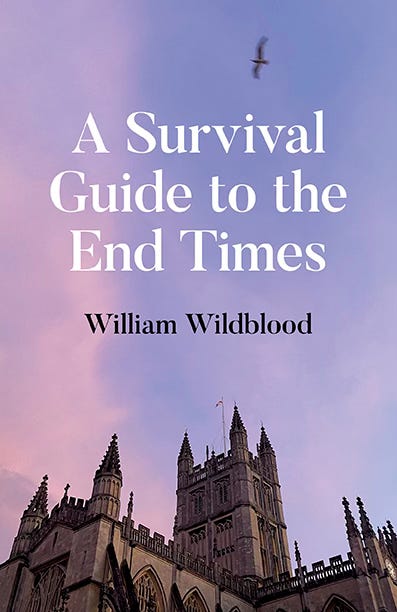
A Survival Guide to the End Times is the latest in a series of books that deal with the spiritual crisis of the present day which, it should be obvious, is the root cause of every other problem we face. 

The series started with Meeting the Masters which describes certain experiences from the earlier part of my life and explains where I am coming from when speaking about these matters. 

There then followed what turned out to be a trilogy of sorts with Remember the Creator, Earth is a School and By No Means Equal which dealt with the reality of God, the reason for our lives in this world, and the soul and how that is a real, immaterial thing.

.

God, the world and the soul are the three fundamentals of our experience but there is a fourth thing and that is time. In most traditional societies time was regarded as cyclical but the Christian West saw it as linear with a beginning, middle (perhaps analogous to the Incarnation) and end. Post-Darwinian materialistic culture took up the linear idea and we generally see time in those terms today though many spiritual people have gone back to the cyclical idea. But what if both are true? Time is cyclical, going through various ages as detailed in Indian and ancient Greek thought to name two of the better known, but it also goes in a line which imparts the notion of progression. So, neither cyclical nor linear but proceeding in a spiral form.

A Survival Guide to the End Times takes up the idea of the present day as being the latter stage in a process of spiritual decay as material forces overwhelm the spiritual, and yet it still sees cause for hope because alongside this decay even now can be found potential seeds for revival in a future age not to mention that the withdrawal of spirit provides valuable lessons that can progress the soul if responded to in the correct way.

Current civilisations will fall but this is not defeatist talk because we are at the end of the cycle so that is as inevitable as the fact that old age leads to death. There is no political or any other kind of solution that can avert the natural course of outer events. The age must come to an end, and the end will likely be chaotic. But from the ashes and debris of the past can come rebirth and the beginnings of something new. The rot and decay must be burnt away as the world crumbles and the sin and lies of the past are destroyed. There will be a wiping clean of the slate for a fresh start which nevertheless will not completely be a case of back to square one because many of the lessons of the previous cycle will have been absorbed by the consciousness of the human souls incarnating at that time.

What this means is that the current age is drawing to a close and that cannot be avoided. But the way we respond to this can have a determining effect on the future, providing seeds of renewal on the subtle level that can sprout when the time is right.